Bone Fracture Treatment
A broken bone is one of those injuries that demands immediate, skilled attention — not guesswork, not delay. Bone fracture treatment, when done correctly and promptly, can mean the difference between a full recovery and long-term complications that affect your quality of life for years.
.jpeg)
A broken bone is one of those injuries that demands immediate, skilled attention — not guesswork, not delay. Bone fracture treatment, when done correctly and promptly, can mean the difference between a full recovery and long-term complications that affect your quality of life for years. Whether the fracture is minor or severe, the approach to treatment matters enormously.
At the clinic of Dr. Mohammed Ali Balharith, consultant in orthopedic and trauma surgery, patients receive a comprehensive evaluation that goes beyond simply setting the bone. Every fracture tells a different story, and the treatment plan is built around that story — your anatomy, your lifestyle, your recovery goals.
What Are Bone Fractures
A bone fracture is, simply put, a break in the continuity of bone tissue. This can range from a hairline crack that's barely visible on imaging to a complete break where bone fragments are displaced and piercing surrounding soft tissue. What's interesting here is that many people assume fractures are always dramatic, high-impact events — they're not. Stress fractures, for instance, develop gradually from repetitive loading and are notoriously easy to miss.
Bone is living tissue, which means it has the capacity to regenerate. When a fracture occurs, the body immediately launches a healing response involving inflammation, new cell formation, and eventually bone remodeling. However, this natural process needs the right conditions — proper alignment, stability, and in some cases, surgical intervention — to result in a solid, functional repair. Understanding what you're dealing with is the foundation of any good treatment decision.
Types of Bone Fractures
- Closed fracture — The bone breaks but does not pierce the skin; surrounding soft tissue remains intact.
- Open (compound) fracture — The broken bone punctures through the skin, creating a significant risk of infection and requiring urgent surgical attention.
- Stress fracture — A small crack caused by repetitive force or overuse, commonly seen in athletes and runners.
- Comminuted fracture — The bone shatters into three or more fragments, usually the result of high-energy trauma.
- Greenstick fracture — Seen primarily in children, where the bone bends and partially breaks rather than snapping completely.
- Transverse fracture — A clean, horizontal break across the bone shaft.
- Spiral fracture — Caused by a twisting force, this fracture winds around the bone and is sometimes associated with non-accidental trauma.
Causes of Bone Fractures
- Traumatic impact such as falls, road traffic accidents, or direct blows to a limb
- Sports injuries involving sudden force, awkward landings, or collisions
- Osteoporosis, which weakens bone density and makes fractures far more likely from even minor incidents
- Repetitive mechanical stress without adequate rest, leading to stress fractures
- Pathological conditions such as bone tumors or infections that compromise structural integrity
- Nutritional deficiencies, particularly low calcium and vitamin D, which reduce bone strength over time
- Workplace accidents involving heavy machinery or falling objects
%20(1).webp)
Symptoms of Bone Fractures
- Sudden, sharp pain at the site of injury that worsens with movement or pressure
- Visible swelling and bruising developing within minutes to hours after the trauma
- Deformity or unnatural positioning of a limb or joint
- Inability to bear weight or use the affected area normally
- A cracking or snapping sound heard at the moment of injury
- Numbness or tingling, which may suggest nerve involvement near the fracture site
- In open fractures, visible bone protruding through the skin
How Are Bone Fractures Diagnosed?
Accurate diagnosis is not optional — it is the cornerstone of effective treatment. Dr. Mohammed Ali Balharith begins every fracture evaluation with a thorough clinical examination, assessing the mechanism of injury, the location and nature of pain, and the neurovascular status of the affected limb. This hands-on assessment provides critical context before any imaging is reviewed.
X-rays remain the first-line imaging tool, offering a clear view of bone alignment and fracture pattern. When greater detail is needed — particularly for complex articular fractures or fractures near joints — a CT scan provides cross-sectional imaging that reveals fragment position with precision. MRI becomes relevant when stress fractures, bone marrow involvement, or soft tissue damage needs assessment. Together, these tools give the specialist a complete picture that guides every subsequent treatment decision.
What Is Bone Fracture Treatment
Bone fracture treatment is not a single procedure — it is a structured process that begins the moment you seek care and continues through rehabilitation. The primary objective is restoring bone alignment, maintaining that alignment while healing occurs, and rebuilding strength and function afterward. How that objective is achieved depends entirely on the fracture's location, severity, and the patient's overall health.
Conservative management works well for stable, non-displaced fractures where the bone fragments are still in acceptable position. Surgical intervention becomes necessary when fragments are displaced, when the fracture involves a joint surface, or when conservative measures cannot maintain alignment. What most people overlook is the rehabilitation phase — even a technically perfect repair can result in a poor outcome if physiotherapy and gradual loading are neglected. Dr. Mohammed Ali Balharith oversees the entire continuum of care, from initial immobilization through to functional recovery.
Complications of Bone Fractures
- Malunion, where the bone heals in a misaligned position, causing deformity or altered biomechanics
- Nonunion, meaning the fracture fails to heal despite adequate time, often requiring surgical revision
- Osteomyelitis, a bone infection that can occur in open fractures or post-surgical cases
- Avascular necrosis, where blood supply to a bone segment is disrupted and the tissue begins to die
- Compartment syndrome, a serious pressure buildup within muscle compartments that demands emergency intervention
- Joint stiffness and reduced range of motion if immobilization is prolonged without accompanying rehabilitation
- Deep vein thrombosis arising from reduced mobility during fracture recovery
Medications Related to Bone Fractures
Medication plays a supportive but genuinely important role in fracture care. Pain management typically begins with non-opioid analgesics such as paracetamol or NSAIDs in the acute phase, though the use of NSAIDs is sometimes limited because of their potential to interfere with bone healing at the cellular level. This is a nuance that many patients are never told about — and it matters.
For patients with underlying osteoporosis, bisphosphonates or other bone-modifying agents may be prescribed to reduce the risk of future fractures once the acute injury is managed. Calcium and vitamin D supplementation is almost universally recommended to support bone repair. In cases where infection is present or risk is elevated — particularly in open fractures — antibiotic therapy is initiated promptly. Dr. Mohammed Ali Balharith tailors the medication plan to each patient's complete clinical profile.
%20(1).webp)
Treatment Options for Bone Fractures
There is no universal protocol for fractures — the right option depends on the specific injury, the patient's age and activity level, and the goals of recovery. Dr. Mohammed Ali Balharith, as a specialist in orthopedic and trauma surgery, evaluates each case individually before recommending a path forward.
1. Non-Surgical Treatment
- Casting and splinting — Immobilizes the fracture in correct alignment, allowing natural bone healing to progress
- Functional bracing — Allows limited controlled movement during healing, used once initial stability is achieved
- Traction — Applies gradual pulling force to align fracture fragments, particularly useful for femoral shaft fractures before surgery
- Activity modification and protected weight-bearing — Used for stress fractures where rest is the primary treatment
2. Surgical Treatment
- Intramedullary nailing — A metal rod is inserted into the bone's medullary canal to stabilize shaft fractures of the femur, tibia, or humerus
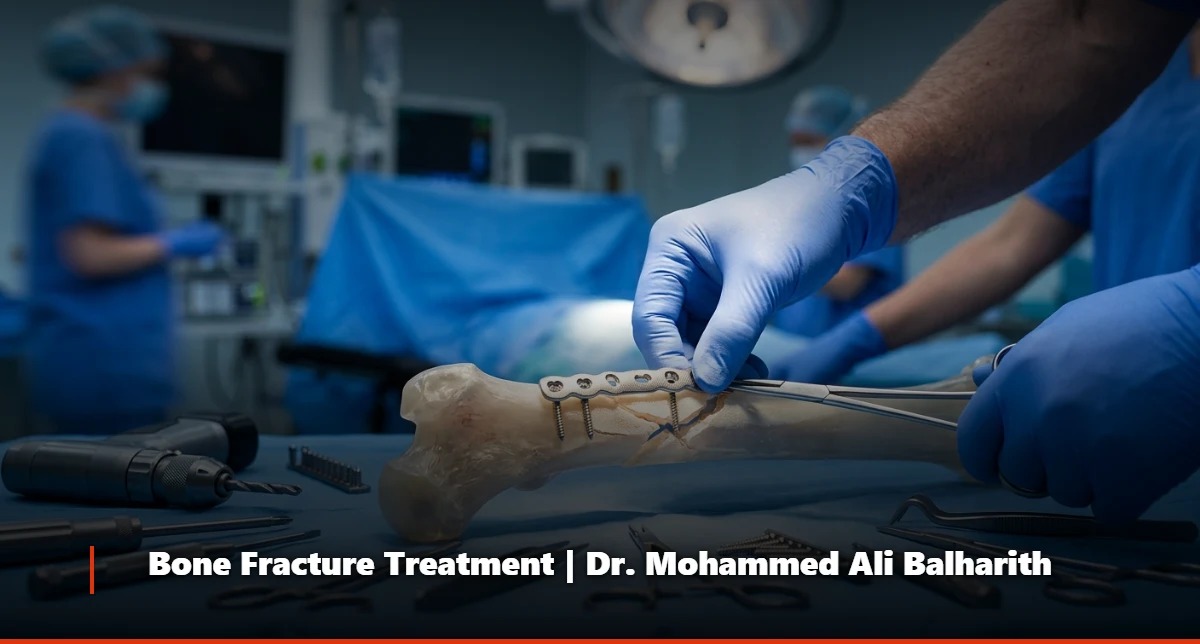
- Open reduction and internal fixation (ORIF) — Fracture fragments are surgically repositioned and secured with plates, screws, or a combination
- External fixation — A frame attached through pins outside the skin provides stability, commonly used in severe open fractures or polytrauma
- Arthroplasty — Joint replacement becomes the preferred option when fractures destroy a joint surface beyond reliable repair
Duration of Bone Fracture Healing
Healing time is one of the questions patients ask most, and the honest answer is: it varies significantly. Simple fractures in healthy adults often show solid union within six to eight weeks. More complex fractures — those involving joints, load-bearing bones, or patients with compromised bone metabolism — can take three to six months or longer before full functional recovery.
Age, nutrition, smoking status, and the quality of the blood supply to the fracture site all influence healing rate. Here's the thing — the timeline your surgeon gives you is based on averages, but your biology is individual. Regular follow-up imaging with Dr. Mohammed Ali Balharith tracks the progress of healing and ensures the treatment plan adapts if healing is slower than expected.
Potential Long-Term Complications of Bone Fractures
- Chronic pain at the fracture site even after radiological union, sometimes related to nerve or soft tissue damage
- Post-traumatic arthritis developing in joints affected by intra-articular fractures
- Leg length discrepancy following growth plate injuries in children
- Reflex sympathetic dystrophy (complex regional pain syndrome) causing ongoing pain and sensitivity
- Hardware irritation from internal fixation devices requiring secondary removal surgery
- Reduced bone density in the surrounding area due to prolonged immobilization
Recovery Tips After a Bone Fracture
- Follow your orthopedic consultant's immobilization instructions precisely — removing a cast early or bearing weight before clearance can undo weeks of healing.
- Attend every scheduled follow-up appointment so that X-rays can confirm healing progress and any complications are caught early.
- Begin physiotherapy as soon as your surgeon approves it — early controlled movement prevents stiffness and muscle wasting.
- Eat a diet rich in calcium, protein, and vitamin D to give your bones the raw materials needed for repair.
- Avoid smoking entirely during the healing phase, as nicotine significantly impairs bone regeneration and increases nonunion risk.
- Manage swelling actively in the early weeks by elevating the injured limb and applying ice as directed.
- Communicate any new or worsening symptoms — increased pain, numbness, or skin changes under a cast — to your care team immediately.
Fractures are not all the same, and they should never be treated as if they are. Effective bone fracture treatment demands an accurate diagnosis, a well-chosen treatment strategy, and committed follow-through — from the acute phase all the way through rehabilitation. Every step influences the final outcome, and shortcuts at any stage carry real consequences.
If you or someone you know is dealing with a suspected or confirmed fracture, do not wait. Contact Dr. Mohammed Ali Balharith, consultant in orthopedic and trauma surgery, today to schedule a thorough evaluation and receive a treatment plan built specifically around your injury. The right care from the start sets the foundation for a complete, lasting recovery.
Related
questions
Ready to talk
about your joint?
Dr. Mohammed Ali Balhareth — consultant orthopedic surgeon specializing in hip & knee replacement, reconstruction, and trauma surgery in Riyadh.
WHATSAPP THE CLINIC ↗Dr. Sulaiman Al Habib Medical Group — Al Hamra Hospital
Sun, Tue, Wed · 4:00–8:00 PM